Showing posts with label education. Show all posts

Monday, 13 August 2018

Holidays, Field Trips and Home Education

Stonehenge

People often ask us if we take the school holidays off. The simple answer would be no. We don't stop learning for the holidays. Psst neither do school kids! 

In fact we don't really change our way of learning much at all although we may privilege certain experiences over others. School holidays are great times to work on socialisation skills, spending time with friends and family who are more available. 

It's also the moment to learn new skills or activities that our normal schedule doesn't leave time for. Things like swimming lessons and sewing projects, gardening, cooking and kayaking.

Mont St Michel

Another thing our holdiday's are full of are field trips. On our recent trip to the UK we took in Utah Beach, The Mary Rose, Stonehenge, Glastonbury Tor, the Roman Baths and Fashion Museum in Bath as well as Darwin's House and the Mont St Michel. 

Some of those visits responded to areas of interest and studying we've done over the last years, others will kick start new interests and some are just because they're interesting and on the way. Follow up work might include watching documentaries, writing a report or reading up about something we found out that intrigued us.
 
Learning how to shoot arrows!

So Maya (12) has read up on women's fashion and prepared a report after the Bath visit. Lotta (6) is learning about the iron age and how StoneHenge was built. Noah (8) continues to be fascinated by WWII and has just got a load more books out of the library on just that subject. Visiting Utah beach was a dream come true for him. 

Learning really is something that is happening all the time for all of us. But it's not just classroom style learning, reading or writing or solving a problem. It's also learning how to interact with other human beings. And it's learning how to take good care of yourself and others. It's discovering what you enjoy and what makes you excited and passionate and want to know more. 

All these things don't stop for the holidays, so neither do we. For us there's no strict time on and time off if you like, but rather a continuum of projects and living and projects and sleeping and eating and living and projects. May it so continue! 

The Mary Rose in all her glory

Friday, 15 June 2018

Visiting Historical Sites - one great way to make sure History is fun!

We study a lot of history. Noah (8) is history mad and I come from a family that's always liked this subject. I love watching history documentaries and reading history books. And when I wrote this piece about Fun Educational History Activities I shared many of the other things we do to keep history interesting. Today however I'd like to tell you how field trips are one great way to make sure History is fun for your kids. 

History Fun Oxford

Field trips for me are quite unlike the other tools in the educational arsenal. They have the power to be really memorable experiences that stay with us long after we've stopped studying whichever period of history prompted them. Memorable visits for me included Tintern Abbey, Falaise Castle in Normandy and a local WWI memorial. 

History Fun Henvy IV Eleanor of Aquitaine

However, despite how fun and interesting history field trips can be it's important to follow a few principles if you want them to turn out that way. Here's my take on the best way to make sure your history inspired visits make sure history is fun!

One - Don't do too much

As adults particularly if we've travelled far like for example when we're on holiday, we want to try and cram in as much as possible. But this is the opposite of best practice with kids. 

History Fun Egyptian jewellry

When we ask our kids whether on family or school trips to visit too many museums, memorials or Cathedrals (mum?) in one go these visits can have the opposite effect to the one we're aiming for. Yes, for kids visiting more than one site in a day or all the Normandy beaches in a week is nearly always too much. 

Fun History Visiting Historical Monuments with Kids


Instead take time to really discover and appreciate one place. And make sure you leave time in the day for fun stuff like playing at the beach, swimming in the pool or just running around at the campsite. Kids are way more likely to enjoy themselves if they know their favourite activities haven't been forgotten.

Two - Don't stay too long

Just like golden rule number one, this one is really important. We all know what it's like you feel like you've barely got there and the kids are already asking if it's time to go home, to the beach, for an ice-cream etc etc. 

Histtory fun egytian jewellery

This can be really frustrating for us adults who'd really like to see that fourteenth century tapestry on the top floor with its original stitching details! But remember, go past their enthusiasm point and they'll be left with a bad taste in their mouths. 

Histtory fun egytian jewellery

We're not saying it's okay to leave after five minutes but be realistic about how long is long enough for you children given their age and level of interest in the site. And if you'd really like to stay longer than try some of the following tips to make them want to stay longer too!

Three - Plan the trip ahead  

Okay, so this isn't always possible, sometimes you stumble on a hidden treasure, something unexpected. That's okay those can be discoveries. However, on the whole I've found a bit of planning can go a long way.

History Fun Louvre Museum Kids

Mostly this means, talking to the kids enthusiastically about the places we're going to visit. Recently however we planned a Louvre visit by getting a book about the museum from the library and picking out ancient artifacts we wanted to see. 

History Fun Roman Arch

Last year for our trip around the Loire valley, I went as far as making a personalised guide book for all the kids in the party. This included photos and brief descriptions of all the castles we intended to visit. Beforehand I'd spent time researching each monument to make sure I privileged the most interesting ones for kids.  Which leads me to my next tip.

Four - Pick sites which cater to kids

Many historical monuments now offer activities for children. These range from workshops to discovery trails and worksheets. I can't emphasize how worthwhile it is to make the most of these resources. 

History Fun Kids Dress Up at Castles

history fun car rides fontevraud abbey

Planning on an abbey? Pick Fontevraud if it still has its amazing toy car racecourse! Visiting a castle? Pick one that has dress-up clothes to put on or sword fighting to watch. Going to a roman monument? Remember to do what I did last week in Saintes and ask if they have anything for kids. They did, a great little workbook about amphitheatres and gladiators. What about a guided tour just for kids? These can be really fun like the one we did in Langeais where an actress dressed up as Queen Anne of Brittany to guide them round her 'home'.

History Fun Castle Ramparts

Kids love getting stuck into these kinds of activities and they can really help you get that longer visit you were hoping for! To find out what a specific site has to offer, consult their web page or ring them up. Lots of sites really do offer fantastic activities. 

Five - Let them loose with a camera

Okay so maybe not your super expensive dslr! But kids love taking pictures and through the lens they'll often spend a lot more time looking at details than they otherwise would. Here our some of our kids photos!

History Fun Kids Knight in Amour

History Fun Kids Camera

History Fun Kids Capture Details

History Fun Kids Take Photos

History Fun Kids Take Photos
 
So to sum it up, plan your visits, pick places that have thought about how to make their visit fun for kids, only do one site in a day and not too many visits in a small space of time and don't stay too long! Oh and if your kids are anything like mine it usually helps if the site has a shop and a small amount of spending money is made available to cover costs 😃 !


Friday, 25 May 2018

On the Road

Yes we've been on the road recently, hence the online silence. Somehow I never seem to be able to travel, take photos and get round to uploading them and writing blog posts all at once. 

In fact generally I'm not that great a multi-tasker. I put it down to my mindfulness practice, all that when knitting just knit, when washing up just wash up has kind of cured me from doing lots of things at once. 

So we've been out and about on the road in Great Britain, France and Holland! Well that last one was only me, but hey solo trips are fantastic right? They really recharge the parenting, home educating batteries like nothing else. 

So here's some eye candy for you from our fun times. As usual we combined family, friends and some educational visits along the way. Home schooling never stops not even for holidays! We really believe in learning all the time just like our man John Holt said.

Celebrating 12 with her grandparents!

Bird watching at the amazing Rutland Waters

Catching up with British cousins

And French cousins


The Eiffel Tower

 
The Louvre


The Louvre encore

Copying hieroglyphs

Cousins drawing together

Amsterdam crochet and bikes of course!

Amsterdam, city of bicycles


Thursday, 19 April 2018

Making Science Fun : Exploring the Solar System with Kids


Science Fun Solar System Kids Rocky Planets size and distance
Noah looks out on the solar system

Space has often featured quite highly in our homeschooling as at one time or another it’s interested different members of the family. Perhaps you remember the space station we made when Noah was obsessed with Tim Peake? So it’s no surprise that we had a blast exploring the solar system together recently.

Making Science Fun is easy when you have great hands-on activities to do as well as entertaining videos to watch and good textbooks. For the Solar System we were inspired by the amazing book Astronomy Lab for Kids by Michelle Nichols. The 52 activities inside our inspiring and challenging. Even better they use household supplies so you don’t have to run out and spend a lot of money on extra equipment – yay!


Introducing the Solar System


To begin our study of the solar system. I first asked the kids questions like what do you know about our solar system? And, can you name any of the planets? We then watched some videos suggested by national geographic. They were a fun mix with some songs and funny stuff mixed in.


Getting an idea of scale


Once we’d familiarised ourselves with our solar system we got ready to do a demonstration from the Astronomy Lab for Kids book called, Take a walk on the rocky planets. The rocky planets are Mercury, Venus, Earth and Mars – the four closest to the sun. The other planets are gassy planets.

To do this demo we first had to make a giant circle to represent the sun. We followed the instructions in the book and taped together pieces of A4 until we had a big enough square to trace a circle with a 92cm diameter. We also followed the instructions to trace our circle. What we did was tie a 46cm piece of string to a pen and then held the string down in the centre of the paper while we used the pen to trace the circle. This was a great skill for the kids to learn.

Solar System Sun Model Rocky Planets


Next we made the 4 rocky planets our of play-doh. This was actually quite hard as they had to be really tiny, we’re talking mm. The kids really enjoyed trying and measuring them to see if they were the right size. We then taped our play-doh planets to pieces of paper with the names of the planets on them. Be careful if you do this to make sure the little play-doh planets are well attached or you might lose them like we did! 


Science Fun Solar System Kids Rocky Planets
 

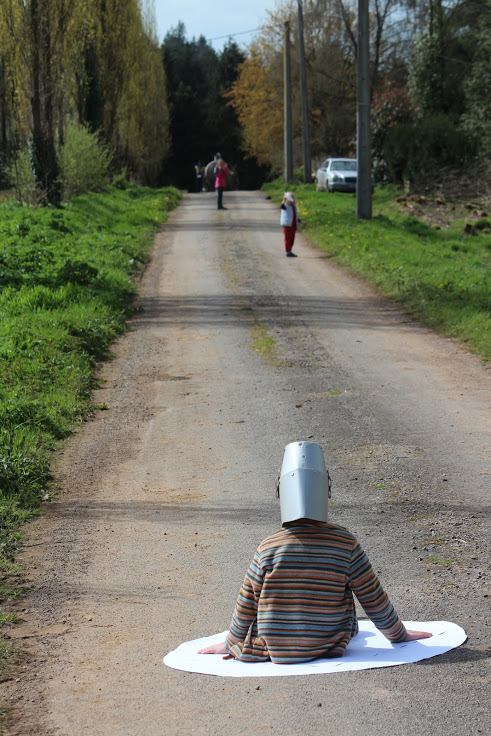
It was now time to head outside. First we placed the sun right at the far end of the (very quiet, read virtually unused and private) road outside our house. Noah (8) sat down on the sun. Yes, he is wearing a helmet as he decided he needed to dress appropriately if he was going into space! 


Science Fun Solar System Kids Distance between Planets
 

Lotta (5) and I then paced out the 62 steps to get to Mercury. The steps had to be approximately 60cm long. We used a tape measure to check. Lotta sat down holding Mercury.


Science Fun Solar Sytem Kids Mercury

Maya (12) then paced out the 54 steps to Venus. Then I took 45 steps and placed the earth and finally my husband Frank paced a whopping 84 steps to be Mars.

Science Fun Solar System Kids Venus

This experiment was easy to set up because we had all the supplies on hand. It was fun to execute. I told the kids we were going on a space journey to see how far the rocky planets were from the sun. It was brilliant for getting an idea of the scale of things in space, not only the distances between the sun and the planets but also how giant the sun is compared to the rocky planets.

The kids really enjoyed not only the making part of this but also the demo.


Making a Model of the Solar System


Later on that day we worked on three different models of the solar system to help fix what they’d been learning in the kids minds.

This was really easy to adapt to different ages. For Lotta, I printed a picture of the solar system to colour in then traced it onto water colour paper because she decided she’d like to paint the solar system. She really enjoyed painting although it was a bit fiddly with some of the smaller planets. If I were to do this again with a five year old I’d probably scale it up so it would be better adapted to their fine motor skills. 

Science Fun Solar System Kids Make Model
   
Noah was lucky to have one of these. His sister has one too but she painted hers ages ago. It had been sat in his drawer for a bit and our morning’s activities really fired up his enthusiasm. He really enjoyed using our DK encyclopedia to make sure he painted all the planets accurately.

Science Fun Solar System Kids Make Model

Finally, Maya drew the solar system in a circular fashion to show the planets in orbit round the sun. She added a scale across the bottom which shows distances between the planets. And also a section on the right of her paper to write a little bit about each of the planets. Again she used the DK Encyclopedia for information. 

Science Fun Solar System Kids Make Mmodel


Classifying the Solar System


Our final activity was a sorting game. This activity also came from Astronomy Laboratory. I printed off about thirty pictures of our solar system and the children took it in turns to put them in groups based on their own organsiational systems. The other kids then had to try and guess what their categories were. 

I was pleasantly surprised at how much the kids loved this simple game to the point that they got up and started playing it again the very next day!


Conclusion


Making science fun is easy if you use good books, hands on demos or experiments and let them express themselves when recording what they've learnt. 

Exploring the Solar System has been a really memorable and rewarding experience so far. Yes, so far because we still have a whole host of other projects from Astronomy Labo we'd like to try out as well as some more fun looking documentaries to watch! 


Friday, 9 March 2018

Lava Lamps : The Ultimate Kids Science Experiment

Lava Lamps have to be one of the funnest science experiments we've ever done. Seriously, if you want to know how to make science fun for kids and encourage their sense of wonder you can't look much further than this.

Experiment - check, there are fluids and solids involved and  scientific gear required. Hands on - check, lots of pouring, mixing, shaking. Relevant - check, who doesn't think a funky lamp like this would be a great addition to any kid's room? Can be supported by interesting documentaries - check, and books - check.

So on to the details.  

kids fun science experiements lava lamps
Bubbling Beauty - Lava Lamp

Lava Lamps


Materials

  • Clear glass or plastic bottle
  • Vegetable Oil (liquid)
  • Water (liquid)
  • Food Colouring (liquid)
  • Alka Seltzer tablets(solid)


What we did

  • First we poured the vegetable oil into a tall glass jar.
  • Then we used a dropper to drip water into the oil This meant the kids could see how the water didn't mix with the oil but sank through it to pool at the bottom. I prompted their observations by asking them to watch what happened and describe it to me. We then talked about how this was because the water was denser than the oil. If you look closely at the picture below you can see the water droplets beginning to cluster at the bottom of the jar.


Kids fun science experiments lava lamps
Dripping water into the oil

  • We did the same with the food colouring and again observed how it passed through the oil and then mixed with the water.

Kids science fun experiments lava lamps
Passing through the oil

kids science fun experiments lava lamps
Mixing with the water

  •  We took half an alka-seltzer tablet and dropped it into the jar and watched what happened.


Kids Science Fun Experiments Lava Lamps

Kids Science Fun Experiments Lava Lamps
Watching the Reaction


  • We asked ourselves what else we could experiment with? What would happen if we put the lid on or dropped in a whole alka seltzer tablet? We also added some blue food colouring to the red to see what that would do. And then we got out our biggest torch and put it underneath the bottle.


Kids Fun Science Experiments Lava Lamps
Watching to see what happens!

Kids Science Fun Experiments Lava Lamps
Lovely Shades of Purple


  • And just for good measure, we made some more! Three children often means three experiments. We began this together but luckily I had just enough oil and alka seltzer for them to do it again in smaller jars. This time they each worked by themselves and tried out some things differently to see what happened. Shaking happened, tipping upside down happened, adding differing quantities than the first time happened. And a lot of smiling and delight in the magic bubbles each and every time.

Lotta (5)


Noah (8)


Maya (11)


Best for...


Our sense of wonder. If you had to ask me what was the single thing that made this the ultimate kids science experiment for me so far, it would have to be the sheer delight on my kid's faces every time those bubbles appeared. With such simple and easily obtainable ingredients we did something really special.  There is something amazing about Lava Lamps. They reveal the beauty and wonder of chemical reactions between liquids, solids and gases in a very peaceful and stunning way. 


Kids Science Fun Experiments Lava Lamps
Watching the Lava Bubble
 
In conclusion, we had great fun with this experiment. It allowed us to continue exploring states of matter (check out our other experiments here) as well as the concept of density. As usual we wrote the experiment up on paper (more about how that works for kids of different ages next week) and talked about the science. We also learned about how real lava lamps are made by watching this documentary as well as reading about chemical reactions in our science books.