Showing posts with label homeschooling. Show all posts

Monday, 13 August 2018

Holidays, Field Trips and Home Education

Stonehenge

People often ask us if we take the school holidays off. The simple answer would be no. We don't stop learning for the holidays. Psst neither do school kids! 

In fact we don't really change our way of learning much at all although we may privilege certain experiences over others. School holidays are great times to work on socialisation skills, spending time with friends and family who are more available. 

It's also the moment to learn new skills or activities that our normal schedule doesn't leave time for. Things like swimming lessons and sewing projects, gardening, cooking and kayaking.

Mont St Michel

Another thing our holdiday's are full of are field trips. On our recent trip to the UK we took in Utah Beach, The Mary Rose, Stonehenge, Glastonbury Tor, the Roman Baths and Fashion Museum in Bath as well as Darwin's House and the Mont St Michel. 

Some of those visits responded to areas of interest and studying we've done over the last years, others will kick start new interests and some are just because they're interesting and on the way. Follow up work might include watching documentaries, writing a report or reading up about something we found out that intrigued us.
 
Learning how to shoot arrows!

So Maya (12) has read up on women's fashion and prepared a report after the Bath visit. Lotta (6) is learning about the iron age and how StoneHenge was built. Noah (8) continues to be fascinated by WWII and has just got a load more books out of the library on just that subject. Visiting Utah beach was a dream come true for him. 

Learning really is something that is happening all the time for all of us. But it's not just classroom style learning, reading or writing or solving a problem. It's also learning how to interact with other human beings. And it's learning how to take good care of yourself and others. It's discovering what you enjoy and what makes you excited and passionate and want to know more. 

All these things don't stop for the holidays, so neither do we. For us there's no strict time on and time off if you like, but rather a continuum of projects and living and projects and sleeping and eating and living and projects. May it so continue! 

The Mary Rose in all her glory

Thursday, 21 June 2018

How to be observant


Observation is one of the cornerstones of any good scientific process. All good scientists know they need to look closely at things to work out how they work or notice minute changes if they're conducting an experiment. They have learnt how to be observant.

"Observation is essential in science. Scientists use observation to collect and record data, which enables them to construct and then test hypotheses and theories." (Science Learning Hub)

 
Today I'd like to share with you one way we've been fostering observance in our home education through natural sciences. Many children have a natural interest in the outdoors, in nature and animals. Fostering this interest and using it to encourage careful observation is an excellent way to encourage your children's scientific tendencies.


What this means for us is many different things. It may be spending time by the riverside or at the beach. It might be leaf collecting or painting tulips, going bird watching or star gazing. All these activities cultivate not only great observation skills but our children's sense of wonder


The activity I'd like to share today is botanical drawing. That sounds fancy but round here it mostly means taking time to draw, colour and paint plants and flowers. 


Supplies

  • Nature journal or paper. We like water colour weight paper best either in notebooks or loose leafed. We also love water colour postcards. 
  • Drawing pencils
  • Coloured pencils or felt tip pens or watercolour paints. The latter are our favourites because we're big fans of botanical books and they're often illustrated with watercolours.*
  • A frame or things to mark out a square (we used four barbecue skewers) 
 

Method 1 Nature Trail

  1. Take turns to be the guide. The first guide leads everyone to a plant or flower of their choice.
  2. Everyone draws the flower or plant. 
  3. Take time to observe the details, the shapes of the leaves or petals. 
  4. Add colour.
  5. Once everyone has finished, the next guide leads them to a new flower or plant. 


Observing and drawing flora and fauna has been part of education for centuries. Keep your eyes peeled for examples in old books, on postcards and tea towels. Or in Cecily Mary Barker's delightful and accurate Flower Fairies Books.


This activity encourages children through art to explore flora and fauna. Drawing activates our observational skills in a different way to photography for example or using words. 


Method 2 Make a Scientific Record of a Designated Space

  1. Someone picks a spot (on the grass, in the soil, on the forest floor...). Place your frame on the ground. 
  2. Record what you can see in the frame in a drawing. 
  3. Add colour if you wish.
  4. This can be repeated in as many locations as you wish.

This activity is actually very similar to what botanists do out in the field. They make Plant Surveys. They do it to find out how many of a particular species is present in a particular place or to discover the distribution and populations of many plants in a particular place.


In our version the emphasis is on observing what's there and finding a way to record it. So far we haven't explored the idea of trying to tabulate this in a graph or table. 


To extend this activity, grid your frame so you can be even more precise about distribution and use graph paper to make an even more accurate representation. 

Be Observant Together  


Children of all ages can enjoy botanical drawing. The important thing is that whichever activity you pick to do, make sure you do it with your children. Seeing you observing and drawing is the best encouragement there is!

 
*Matt Sewell is one of our favourite illustrators. We love his gentle water colours which make the  birds seem so vivid.

Thursday, 31 May 2018

Learning All The Time

Learning home education art in the art gallery
Making Art in the Art Gallery

Learning all the time is the title of one of my favourite John Holt books on home education. For me it sums up the basic tenet of our home schooling and the cornerstone of my philosophy of life. Learning is not something to be confined to one place or one time, but is as natural to us as breathing.

Learning about Flowers

Henry Ford said,

"Anyone who stops learning is old, whether at twenty or eighty. He who continues to learn stays young. The greatest thing in life is to keep your mind young."

And I'm reminded of one of my friend's from our local knitting club. She's in her seventies and still learning all the time. The look of enthusiasm on her face as she told me recently about a botanical outing by our local river said it all. Stay curious, take every opportunity to learn and you will find and enjoy the wonder in the world around you. 

Learning all the time, lys, observation
Lys du jardin - spot the visitor!

Experience tells us that as we get older we sadly tend to lose the open eyed view of the world we cherish in our children. Our experiences constantly modify our interpretation of everything we do. The innocent curiosity of childhood is lost to our judgements, knowledge and the tired paths our neurons keep traveling. And time seems to pass faster.

Learning all the time, rambling rose and bee
Rambling Rose Albertine and Friend

According to Douwe Draaisma, dutch psychologist and author of Why life speeds up as you get older, that's because as we get older discoveries and novelties tend to become rarer. As a child we are adventurous, big exciting experiences and discoveries are common. First trip in an airplane, first time sleeping in a hotel, first day at school, first time buying the bread all by yourself. 

learning all the time petunia stamen
First time I saw the stamen

But if we're learning all the time, if we make a conscious choice to look at the world with what the Buddhist's call the beginner's mind, then we can stay young of heart and mind.


learning all the time pivoines
Pivoine - my wedding flowers - gift for our 10th anniversary

Practically speaking this might mean starting something new, trying a food you've never tried before or taking a walk in silence listening to the noises around you as if you've never heard them before. Or why not reading a new book? I could probably have called this reading all the time and the point would have been the same! Try a new author or a completely new subject. Check out the wonderful brainpickings.org for new ideas. You could even join their weekly newsletter? 

learning all the time spotting the tiny things
Fly on the Hortensia - spotting the tiny things!

I suppose above all what I'm getting at is a quality of attention. The same quality I try to bring to listening to my children. The same quality I bring to my photography (alongside practice - see Observe, practice, be grateful). The same quality I seek when I'm writing poetry. And the same quality I hope my children will foster throughout their lives, not just to stay young but to stay filled with wonder at this wonderful world we are so lucky to live in!

P.S. If you do try something or read something new, please share with me, I'd love to hear about it!

Coming Soon... How botanical drawing fosters mindfulness and scientific observation! 

learning all the time raindrops on maple leaves
Raindrops on Maple Leaves


Thursday, 19 April 2018

Making Science Fun : Exploring the Solar System with Kids


Science Fun Solar System Kids Rocky Planets size and distance
Noah looks out on the solar system

Space has often featured quite highly in our homeschooling as at one time or another it’s interested different members of the family. Perhaps you remember the space station we made when Noah was obsessed with Tim Peake? So it’s no surprise that we had a blast exploring the solar system together recently.

Making Science Fun is easy when you have great hands-on activities to do as well as entertaining videos to watch and good textbooks. For the Solar System we were inspired by the amazing book Astronomy Lab for Kids by Michelle Nichols. The 52 activities inside our inspiring and challenging. Even better they use household supplies so you don’t have to run out and spend a lot of money on extra equipment – yay!


Introducing the Solar System


To begin our study of the solar system. I first asked the kids questions like what do you know about our solar system? And, can you name any of the planets? We then watched some videos suggested by national geographic. They were a fun mix with some songs and funny stuff mixed in.


Getting an idea of scale


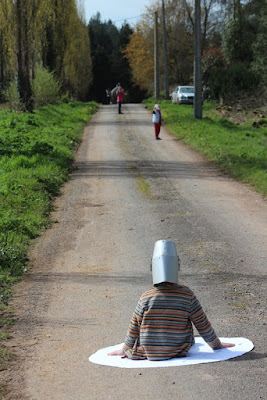
Once we’d familiarised ourselves with our solar system we got ready to do a demonstration from the Astronomy Lab for Kids book called, Take a walk on the rocky planets. The rocky planets are Mercury, Venus, Earth and Mars – the four closest to the sun. The other planets are gassy planets.

To do this demo we first had to make a giant circle to represent the sun. We followed the instructions in the book and taped together pieces of A4 until we had a big enough square to trace a circle with a 92cm diameter. We also followed the instructions to trace our circle. What we did was tie a 46cm piece of string to a pen and then held the string down in the centre of the paper while we used the pen to trace the circle. This was a great skill for the kids to learn.

Solar System Sun Model Rocky Planets


Next we made the 4 rocky planets our of play-doh. This was actually quite hard as they had to be really tiny, we’re talking mm. The kids really enjoyed trying and measuring them to see if they were the right size. We then taped our play-doh planets to pieces of paper with the names of the planets on them. Be careful if you do this to make sure the little play-doh planets are well attached or you might lose them like we did! 


Science Fun Solar System Kids Rocky Planets
 

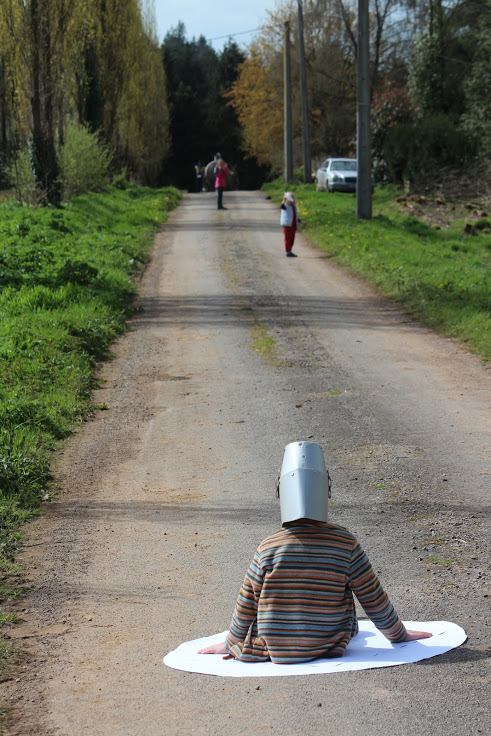
It was now time to head outside. First we placed the sun right at the far end of the (very quiet, read virtually unused and private) road outside our house. Noah (8) sat down on the sun. Yes, he is wearing a helmet as he decided he needed to dress appropriately if he was going into space! 


Science Fun Solar System Kids Distance between Planets
 

Lotta (5) and I then paced out the 62 steps to get to Mercury. The steps had to be approximately 60cm long. We used a tape measure to check. Lotta sat down holding Mercury.


Science Fun Solar Sytem Kids Mercury

Maya (12) then paced out the 54 steps to Venus. Then I took 45 steps and placed the earth and finally my husband Frank paced a whopping 84 steps to be Mars.

Science Fun Solar System Kids Venus

This experiment was easy to set up because we had all the supplies on hand. It was fun to execute. I told the kids we were going on a space journey to see how far the rocky planets were from the sun. It was brilliant for getting an idea of the scale of things in space, not only the distances between the sun and the planets but also how giant the sun is compared to the rocky planets.

The kids really enjoyed not only the making part of this but also the demo.


Making a Model of the Solar System


Later on that day we worked on three different models of the solar system to help fix what they’d been learning in the kids minds.

This was really easy to adapt to different ages. For Lotta, I printed a picture of the solar system to colour in then traced it onto water colour paper because she decided she’d like to paint the solar system. She really enjoyed painting although it was a bit fiddly with some of the smaller planets. If I were to do this again with a five year old I’d probably scale it up so it would be better adapted to their fine motor skills. 

Science Fun Solar System Kids Make Model
   
Noah was lucky to have one of these. His sister has one too but she painted hers ages ago. It had been sat in his drawer for a bit and our morning’s activities really fired up his enthusiasm. He really enjoyed using our DK encyclopedia to make sure he painted all the planets accurately.

Science Fun Solar System Kids Make Model

Finally, Maya drew the solar system in a circular fashion to show the planets in orbit round the sun. She added a scale across the bottom which shows distances between the planets. And also a section on the right of her paper to write a little bit about each of the planets. Again she used the DK Encyclopedia for information. 

Science Fun Solar System Kids Make Mmodel


Classifying the Solar System


Our final activity was a sorting game. This activity also came from Astronomy Laboratory. I printed off about thirty pictures of our solar system and the children took it in turns to put them in groups based on their own organsiational systems. The other kids then had to try and guess what their categories were. 

I was pleasantly surprised at how much the kids loved this simple game to the point that they got up and started playing it again the very next day!


Conclusion


Making science fun is easy if you use good books, hands on demos or experiments and let them express themselves when recording what they've learnt. 

Exploring the Solar System has been a really memorable and rewarding experience so far. Yes, so far because we still have a whole host of other projects from Astronomy Labo we'd like to try out as well as some more fun looking documentaries to watch! 


Thursday, 12 April 2018

Making Science Fun : Our Top Three Science Shows for Kids

We watched quite a few tv shows last week when we all came down with a horrible flu-like virus. It was one way to feel we were still doing some learning. It inspired me to finally get round to writing this blog post and sharing with you another way of making science fun with our top three science shows for kids. 

Screen time can be a complicated thing when you're homeschooling. On the one hand, we've all read the literature about how too much screen time is bad for our kids. On the other, there are just so many great documentaries out there and it would be a crying shame not to exploit them! Because I have to admit I get tired of the sound of my own voice. I don't want my children only to hear and learn things from me. It's important to shake things up, find other teachers. And a really good documentary or TV show can be just that.

Science Max


Science Max is currently one of the children's favourite things to watch period. It's up there with Star Wars and Coco and many other of their favourite films. Quite a feat. Made by the Canadian company TVOkids, it's secret formula is a young, appealing presenter and a fun concept - let's do everything bigger!

Yes, Science Max takes your average experiment even we can do at home and does it again and again bigger and bigger. The kids absolutely love this especially when it involves Phil the presenter getting wet or dirty. I like it because it repeats the science several times in slightly different ways. This means the kids see the science repeatedly but without it being boring. 


Repetition is really important in any learning situation and a show that manages to do this while having my kids and I in fits of laughter is a definite winner. 


Absolute Genius with Dick and Dom


A BBC show, Absolute Genius is a fun, exciting watch. The first two series celebrate famous scientists. They explore the concepts they were working on in fun and entertaining ways. In series three and four they explore technological inventions and then 'monster builds'. 

As with Science Max there's a high entertainment element to be had from watching the two presenters do stuff. It might be getting inside a Faraday cage or fully clothed in a bath or jumping into canoes to study the principles of Archimedes screw. Whichever, it's always funny to watch as well as informative.


C'est Pas Sorcier 


Ok so this one's in French I'm afraid for all you English only speakers out there. But I couldn't make a list of our top three favourite science shows for kids without mentioning it! We love C'est Pas Sorcier because it covers so many different and fascinating topics. It also combines demonstrations with visits to relevant real life sites that illustrate the science. Hey tv show makers out there, why not copy this fabulous french formula for your next science show! 


Although some people might disagree I don't believe watching shows, even as good as these, is enough by itself. We use them wisely in conjunction with books and home experiments to help us understand more fully the concepts we're studying. We usually do anything hands on before we watch the TV shows too. This way the kids go into their experiments in the real position of a scientists who doesn't know what the outcomes might be. 

What TV shows are great for is consolidation through playful repetition and colourful exposition of the ideas and theories we're exploring. And these shows do this so well that the kids often ask to watch them again and again.

These shows are also good at inspiring kids to see science as being something that's fun. With their goofy presenters, the infallible humour of seeing someone get covered in foam and the excitement of seeing a really big or dangerous experiment they inspire my kids to feel passionately that science is worth being interested in. Without them our educational environment would be infinitely poorer. Well done to all those television makers for making such great shows!

Thursday, 29 March 2018

Fun Educational History Activities

I loved History at school. Unlike science, history was always one of my favourite subjects. It's still an area I'm fascinated by. So it ought to be easy for me to plan fun educational history activities for the kids right?

As you know from posts like this one on roman helmets and this one on building roman forts, we like to keep things fun and hands on here. But as Maya gets older our emphasis has also shifted to report writing and written records of the subjects she studies. Sometimes it can actually be a challenge to make history fun for her. 


The factual books that fascinate her brother don't always keep her interest. And she pulls that face, you know the one I mean, when we talk about visiting ruins, castles or any other 'historical' sites. And yet when she gets there she loves it!

So you can imagine I've been tearing my hair out a bit trying to keep our study unit on ancient cultures (Egyptians, Greeks and Romans) interesting and fun.

My own struggles made me think I might not be the only one wanting a little inspiration. There are a lot of wonderful resources out there and we've been exploiting them. Today I'd like to share with you some of the fun educational history activities I've found to keep kids of different ages passionate about history. Bring on Board Games, TV and a bit of Art. I like to think of them as my three secret weapons! 

Board Games


Have you heard of 7 Wonders? The amazing board game that's won every award out there? Well we have and we've been playing it sometimes on a daily basis since October. What can a board game teach us about history? Well for starters it introduced the kids to the 7 wonders of the Ancient World.


Playing the game also introduced the notion of what it takes to build a great civilisation. Is it knowledge, is it military power, great monuments or trade? Or perhaps a combination of all of the above. Now I'm not saying this game will teach your kids all they need to know about building civilisations but what it did for my kids is spark their curiosity and get them thinking. And in my opinion that's gold! 

The other great history inspiring board game we play is called Chronicards. It's a French version of TimeLine*. We're planning to invest in some more though.Check out lists here and here for more ideas. 

It would be remiss not to mention here too online games. Many museums now have games aimed at children on their websites. Spending a bit of time browsing the internet can throw up some really fun games for your kids to play. National Museums of Scotland is one place we've found with excellent and fun activities. This BBC game was also great fun.


Television


As I've said before great documentaries are one of the cornerstones of our home educating life. I like to think of them as the brain food kind of screen time. 

When I look for documentaries I try to identify what aspects of the period or history in general the kids are interested in. For example, on the Romans Noah is fascinated by their military power and strategies so documentaries on the life of a roman soldier were a must. 


Replica of the golden mask of Tutankhamun in the Egyptian Museum


Sometimes I think more about what kind of historical inquiry might interest them. So this documentary about Tutankhamen kept both older children interested because it was organised like a crime investigation. And of course it featured Dallas Campbell who's fast becoming one of our favourite documentary presenters.

Being British I tend to use BBC documentaries. They're always great visually, feature eminent scientists and other experts and have very high production values. I do my research online and we often use YouTube to watch shows. 

Another route to go down is exploring historical themes through film and story. Asking the question how have people interpreted Cleopatra (or other historical figures or peoples) over time is an interesting and valid one. We've looked at texts and films to do this.


Art


This category covers a lot. From model making through dress up and accessory making it also includes producing beautiful visual art to accompany written reports and making things out of Lego.


Yes Lego. Noah (8) is currently what I like to call Lego obsessed. He lives, breathes and sleeps Lego. If I could see into his dreams I'm sure they'd be in Lego. So what's a home educating mum to do but use Lego to learn of course!

Let's take the example of the 7 Wonders and see how Lego got involved. As the kids were already interested in the 7 Wonders and we're studying Antiquity I decided to study them in more detail. I hoped they would help us learn a bit about the great civilisations that built them and inspire the kid's interest. I wasn't disappointed. 

First we watched this documentary. Although quite long all the children (including Lotta 5) found it fascinating. I asked the children how they'd like to record what they'd been learning. Noah and Lotta were both stumped (more about Maya further down). They had no desire to write or draw anything. What about Lego? I asked. They were enchanted. Both went on to construct pyramids.


These were quickly followed up by Zeus' Temple at Olympia and the Temple at Ephesus. Not only did these projects get them thinking about the monuments architecture, how do you build a pyramid? How do you get columns to hold up a roof? They also kept the conversation going about the wonders and what building them meant for their civilisations. We discussed questions such as why did they build them? What did they symbolise? What did building them do for their society? 


Maya didn't choose Lego to express herself, though she wasn't above helping out or making suggestions. Instead she chose to draw each of the 7 Wonders and write something brief about each one. This provided a great opportunity to discuss perspective and architectural drawing. To explore how to represent buildings and space on paper. 


Final Thoughts


Finding fun educational history activities is really about what's at the centre of all our homeschooling. Discovering what our children are interested in and facilitating their learning about it in every way possible.  

As I learnt earlier in the week there's no point trying to teach how Rome was founded to an 8 year old who wants to reenact the D-day Landings! It's more productive to harness his current interest and see where it takes us. 

Maya who's older is much more able to apply herself to learning about whatever I've decided is on the agenda. It remains essential however to bring things to life and make them fun and rewarding for her to study. That might be as simple as getting her books about mummification for her Egyptian studies and letting that be the central part of her report writing. Or it might be as complicated as sewing her her very own medieval dress (coming soon...).


*We actually prefer the French version as it has more information.


Thursday, 22 March 2018

Making Science Fun : Weather Reports

Snow Brittany Making Science Fun Weather Charts
A light dusting of snow


The weather has been rather strange recently hasn't it with late cold snaps and unexpected snow. Perhaps that's why we decided to make our own weather reports. To chart the weather for a week and see what we found out.

I know a week isn't very long but this was just a beginning. An overture if you like into the world of scientific observation, chart making and eventually data interpretation. 

It was a great way of making science fun by combining a crafty activity (chart design and execution) with a hands on one (checking the local weather outdoors) and a computer based one (looking up the wind direction and the weather in other locations). 


Making Science Fun Weather Charts Home Education Geography Maths
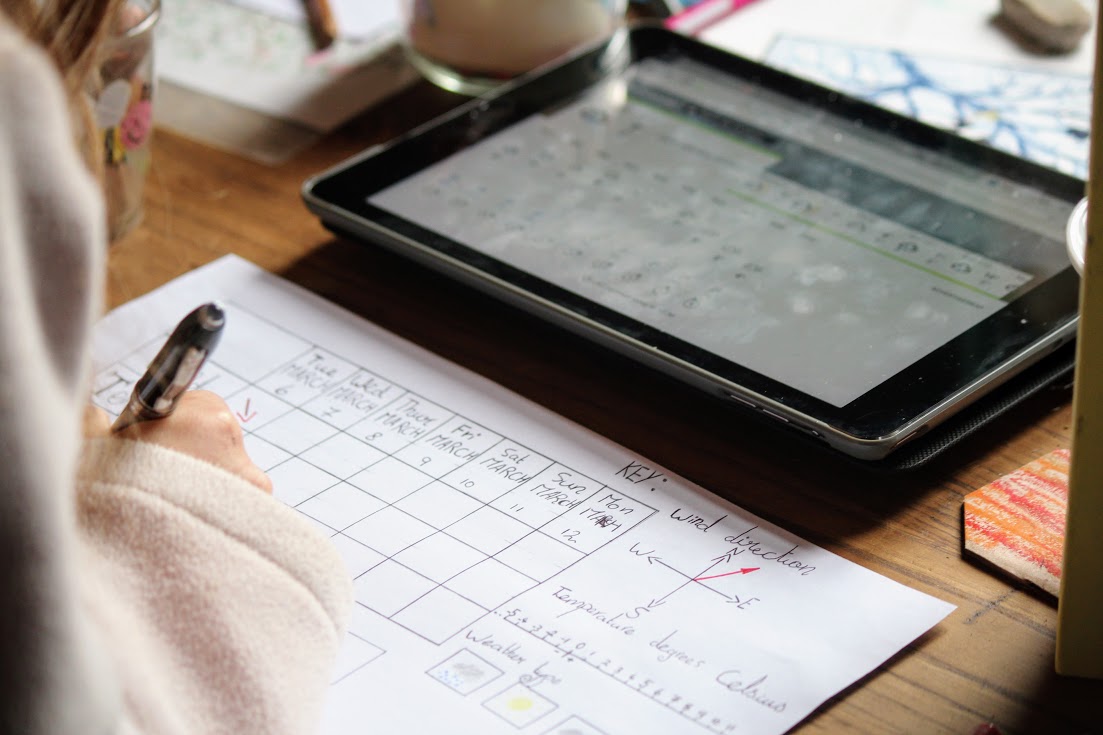
Maya preparing her charts

Observation

Before I tell you how we went about making our charts, I'd like to talk about observation. As I mentioned in previous posts, I think it's important that kids learn about and apply the Scientific Method. Observation is for me one of the cornerstones of any good scientist's (and artist's for that matter!) approach to his work.

"Observation is essential in science. Scientists use observation to collect and record data, which enables them to construct and then test hypotheses and theories."
                                    Science Learning Hub
Observing something and recording your results is a classic scientific activity. Charting your observations is one way of recording your data. 

Encouraging observation skills can begin very early with very young children. It starts by talking to them about things you notice like new buds on the trees or the first blossom. Or how the iced over puddles look like they have trapped stars in them. These kinds of observations encourage children to look closely at things. They foster an attitude of wonder faced with the magic or science of the natural world. 


Making Science Fun Weather Charts Home Education Geography Maths
Lotta's Weather Chart

Record making

This time we chose charts or tables to record our observations. We often record our natural science observations in nature journals (herbiers) and water colour sketches. 

Combining craft and science is probably one of the most effective ways of making science fun for kids. Although this is often fostered in younger children, older kids often miss out on the crafty side of things in school as the work environment gets more serious and focussed on written records. I think that's a great shame as artwork and making things can really help invigorate their studies and help things stick in their minds.

Making Science Fun Weather Charts Home Education Geography Maths
Rainy day in New York City

Making Science Fun Weather Charts Home Education Geography Maths
Snow falling in Paris

Why weather?

My kids have always been interested in the weather and the seasons. They're used to observing it and using that information to fill in the little calendar we have up on the wall. Furthermore, choosing the weather for our first chart making task made this a cross-over activity covering concepts from maths and geography as well as scientific method. 

Making Science Fun Weather Charts Home Education Geography Maths
A book we used for inspiration
 

How we did it

  • First we talked about what a chart is and why we might want to make a record of the weather. We also discussed how meteorologists gather their data. 
  • We looked at some examples of weather charts and decided to chart the weather in our commune (local area), St Barthélémy. Both girls also picked another place to chart.
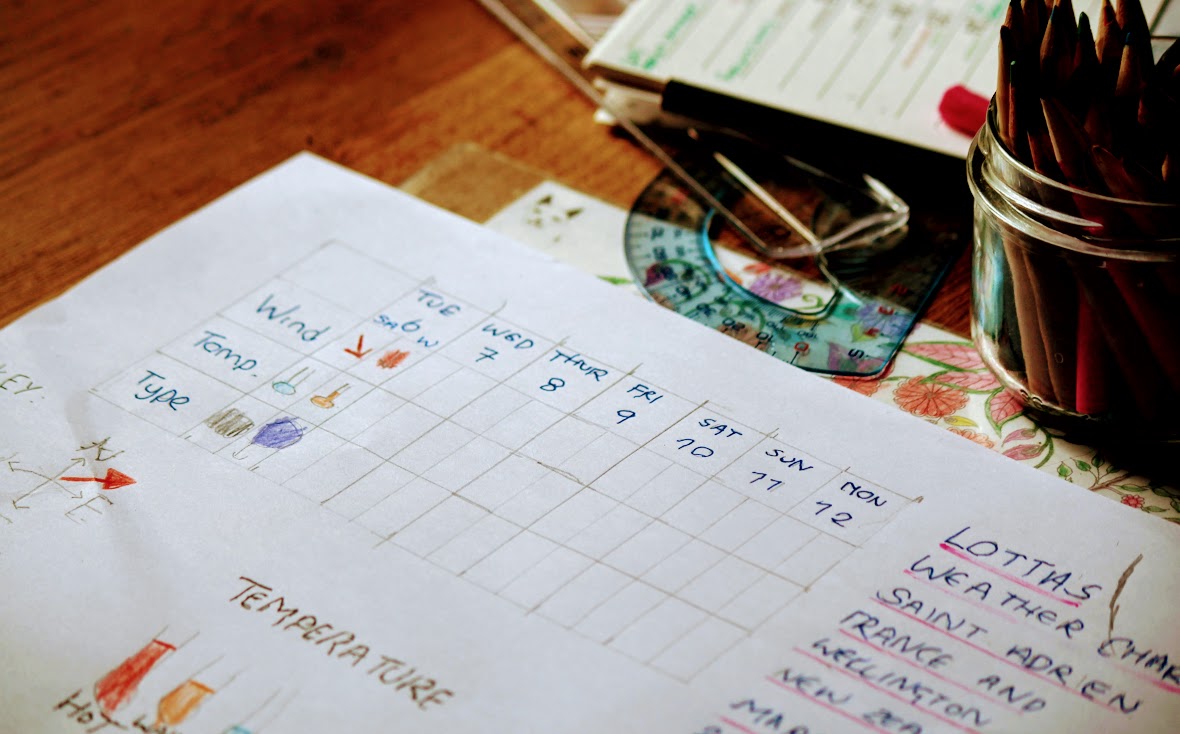
  • We agreed our charts would cover one week and record wind direction, temperature and weather type.
  • We drew up our charts (8 columns and 4 rows)
  • We filled in the days using our calendar to help us* (this led to an interesting conversation about abbreviations such as Mon and how we write the date).
  • We devised a key. This involved deciding on how to depict the weather conditions, the wind direction and temperature. 
  • Our charts were ready to be filled in so we did the first day!
  •  
Making Science Fun Weather Charts Home Education Geography Maths
Using the calendar to fill in the days and dates


Individualization

There are several ways to individualize this project. In our case both girls decided to chart their home town and another place. 

Maya (11) picked Manchester, UK a city we have visited. Lotta (5) picked Wellington City, NZ because she really wants to go to New Zealand. 

The children were also able to personalise their charts by designing their own symbols for the different weather types. They all really enjoyed thinking them up.   

Making Science Fun Weather Charts Home Education Geography Maths
Noah's Weather Chart


Adapting this activity to different ages

This project is easy to adapt to different ages. For younger children you might need to give more help with drawing the table. I began the lines for Lotta at either end and then she did the joining up using a ruler. I also helped her with the writing by doing dot to dot letters for her to trace. She really enjoyed drawing her weather type symbols including a purple umbrella for rain! 

Noah (8) was able to do his table by himself. He needed some input particularly for revising the cardinal points and writing the text. He came up with an airplane symbol to indicate wind direction which was very innovative. 

For an older child like Maya there are lots of ways to make this more complicated. She was able to do her own research online to check the weather report each day. Concerning her chart she also chose to record the temperature in degrees Celsius rather than as cold, warm or hot like her younger siblings. 


Making Science Fun Weather Charts Home Education Geography
Maya filling in her weather chart for Manchester


Recording our Results

We filled our charts in for a week. Although the children did forget at least once each, they were able to complete their charts by asking their siblings. Only Maya the eldest ended up with a hole in her data. I felt this was an important lesson for her to learn, that you need to be constant to get good scientific data.

I know a week might not seem very long, but I felt it was a good beginning without the project becoming tedious. We have enough data to produce a graph, work out an average and a mean, all things I'll be doing with Maya. Most importantly the children ended the project still excited about it!
 
If the children show enough enthusiasm I may suggest doing this again over a longer period. I'd also like to make a rain gauge (pluviomètre) and add rainfall to our chart of local weather at least. They also want to make a traffic chart in our local town though we're waiting for it to warm up a bit first as we don't fancy standing outside for an hour in temperatures only just above freezing!

More tips next time on how to keep history and geography fascinating and fun for all ages! As well as more science with Rainbows in a Jar and our list of some of the best science videos out there.

* The gorgeous artwork on our calendar is by Victoria Keeble. It's published by the people at John Austin cards.