Learning in our house is often very hands on. Like in my best memories of primary school and the TV series Why don't You (you can also watch on youtube), we do a lot of cutting, sticking and general mess making.
Children have a natural desire to make things, they love cutting out and up, sticking, colouring, decorating, painting, making the things they're interested in. I've written about this before and in fact one of our latest crafting activities follows on directly from that post about knights and castles. But what has crafting got to do with our home education experience?
Firstly, I'd like to point out that it often responds to a demand either clearly stated or perceived by me. That sounds vague, what I mean is either, as in the case of the daggers shown here (instructions below), one of the children find a project that interests them and asks if we can do it. In the other case, I sense how interested they are in something and suggest a craft that will explore that. For example, I noticed Noah was reading a lot about castles and their construction and asked him if he'd like to have a go at making one himself. This balance between things the children bring to the table and things I, or my husband, offer is a really important one in our home education and permeates everything we do, be it crafting, reading, watching or participating in activities outside the home.
In both cases doing the craft project fuels their interest in something and a child's interest is a great gateway to learning about all sorts of stuff. For example, plugging in to Noah's interest in castles and knights has led to :
- making a working drawbridge which involved many discussions about weights and pulleys
- watching a series of BBC documentaries about the Castle of Guedelon (Secrets of the Castle) where we've learnt all sorts of things about life in the middle ages - their building techniques and materials as well as how they lived, fed and clothed themselves
- discussing materials and their relative strengths when making things such as daggers, swords and shields
- discussing finances and the cost of things when wishing to buy stuff to do with knights and castles
- reading the Arthurian legends together
So crating helps fuels other learning but it also has great value purely for itself. There are all the fine motor skills involved from using scissors to smoothing bubbles out of kitchen foil! Then there's the necessity of following instructions be they written or in the form of a video (often youtube) or given orally by me. That requires concentration and patience when we don't understand the instructions or each other. It also encourages them to keep things and upcycle them, to pay attention to detail in order to reproduce it and to be patient when things take a lot longer than originally planned.
Aside from all this and the great fun we have together during our crafting times, there is another important advantage. Making things often leads to imaginative play. In this case putting on a costume and a scary face while brandished new daggers. I believe that through imaginative play children make sense of the world and the things they are learning, in this case they play with our history, our past, try on what it might have been like to be a knight or a peasant a thousand years ago or so. As they grow older I hope they'll continue to explore like this through other creative outlets such as art and writing.

 So to making the daggers!
The original idea came from one of the books in this Usborne pack. However due to materials available and the urgency of this project (isn't it always right now with kids) I adapted freely. Here I'll briefly outline the steps we followed to give you an idea:
So to making the daggers!
The original idea came from one of the books in this Usborne pack. However due to materials available and the urgency of this project (isn't it always right now with kids) I adapted freely. Here I'll briefly outline the steps we followed to give you an idea:

- Draw a blade shape on a strong piece of cardboard with a longish oval shaped end like the top of a sword above it's hilt(we traced around the tip of a larger sword to get the shape right at the bottom). Cut it out.
- Draw the shape of a sword hilt on a piece of cardboard and cut it out. Then trace around it and cut out a second hilt. (I free handed this based on pictures from the Usborne book).

- Score down the middle of your blade and then stick a thin piece of cardboard down this middle line (end it with a point like the blade) to produce a little ridge. Do this on both sides.
- Now for the silver foil. This needs to be wrapped around all the pieces as tightly as possible. I applied glue to the cardboard and then we pressed it round gently being careful not to tear and trying not to get too many bumps and bubbles.This step is quite awkward and I had to help a lot.
- Stick the hilts to the blade on either side.
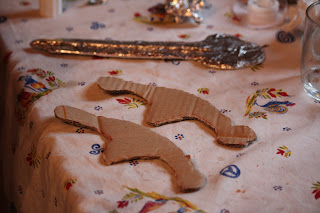
- Finally take some string or in our case wool and wind it around the top of the dagger above the hilt, not quite all the way to the top but covering a fair portion of this part of the dagger. I used double sided sticky tape to secure this at the beginning and then again at the end.

A few years ago I spent some time working with a wonderful woman called Jane Grey. One of the most important things she taught me was to remember to be grateful. Ever since I have tried to practice gratitude in my life. But what does it mean to practice gratitude. Well for me it has taken many different forms. Sometimes I keep a journal full of lists of the things I'm grateful for, I draw, make spider grams, use different coloured pens. At mealtimes I introduced our own kind of grace before we eat. Usually this means holding hands and saying things like
"Thank you for the piggies, thank you to the baker, thank you mummy, I'm so grateful for water!"
Yes, it's often very funny. We have also made gratitude jars and shared what we are grateful for about the birthday person on their special day. It has often just meant trying to think of three things I feel grateful for about my day in that moment before I go to sleep just as I feel consciousness slipping away - it's a wonderful day to go to sleep with a smile. This blog has also been underpinned by a desire to somehow hold on to the things I am grateful for - to notice them and name them because when I open my eyes I see that despite the many difficulties life throws at us, I am incredibly blessed.
Now this language, saying grace and being blessed may sound religious but for me it is not. Perhaps it is spiritual if taken in the sense of nourishing your spirit, that part of yourself that is uniquely you. I see it as also as a special kind of mindfulness - an awareness of what's around me and the joy it brings me. And of course, being aware of all these things often feeds into my creative life too.
In my bid to be more organised here and to encourage my mindfulness and gratitude practice, Five Little Things will be making a regular appearance here. Sometimes just as photos and sometimes with words. I hope you'll like it. And without further ado here's my first Five Little Things...
When people find out we home educate it often sparks off a lot of questions about how we do it. Is it like school? Are you the 'maitresse'? (french for primary school teacher). Do you cover all the subjects?
It's hard to answer all those questions at once and it also made me think about how diverse home education is and how little most people know about what our kind of home education looks like. So I decided I'm going to write more about it here. I'll be posting once a week about a different aspect of our homeschooling life and hope that will be the best way to inform others about what our kind of home education is really like.
The first thing to explain is our educational philosophy. We believe in internal motivation, in learning things because you are interested in them, because you want to or need to know more about them. That's in contrast to external motivation - things we learn because we have to or to please someone else be it parents or teachers. Let me try and explain that a bit more.
In most schools we learn what we are told to when we are told to do it, we have no control over the curriculum. We learn these things as best we can whether they interest us or not, whether they are useful to us or not because we are told we must. A large part of our learning is therefore externally motivated by this necessity.
In our home, our children learn about the things that interest them be that ponies, space stations, trains or chess. They persue these interests with our help as fully as they can as long as they want to and in so doing often they find they need to learn other things to go further in their understanding. Those things might be maths or physics, writing or reading - all the classic subjects. However, we rarely sit down and try to learn those subjects independently of our children's need unless of course they want to which is true in the case of maths which the older two both love and at the moment Latin which is something I wanted to learn and asked them if they'd like to do that together.

Other terms for this kind of approach are child-centred learning or autonomous learning. And for us it does not mean we never use any formal learning materials or techniques. And it does not mean our children sit around all day watching television and eating sweets as this article from the Independent implies and many people might imagine.
Here it looks a lot like doing a puzzle. The children move through different passions or interests and slowly put together a big puzzle of the understanding they need to make sense of the world. I like this description from Alan Thomas and Harriet Patterson's great book How Children Learn at Home, a detailed study of homeschooling:
"Its products are often intangible, its processes obscure, its
progress piecemeal," they say. "There are false starts, unrelated bits
and pieces picked up, interests followed and discarded, sometimes to be
taken up again, sometimes not... Yet the chaotic nature of the informal
curriculum does not appear to be a barrier to children organising it
into a coherent body of knowledge."
You can read more about their study and families working like this here in this fairly balanced article from The Guardian. I love this quote from a homeschooling mum
"I provide materials, resources, help with research, discuss what they
are reading and what I am reading, watch documentaries with them, have
stimulating conversations, listen a lot and answer questions."
This fairly sums up how we do things. Lots of questions, spurts of interest in things, passions for some, time spent on learning what interests each child when it interests them. It's an approach that demands two important things from us. Firstly that we share our passion for learning with them and give them opportunities to encounter many different things in order that their own interests be awakened. Secondly, that we take on the role of an educational facilitator or companion, helping our children to find the knowledge they need and also, and in my opinion very importantly, helping them to learn how to find that information for themselves. (See my post about Why I love Libraries).


